Vampires
My Vampire Love (Completed)Vampires are the dominant supernatural species in the narrative, distinguished not merely by predation or immortality but by bloodline, law, political rank, and controlled reproduction. Their society treats pure blood as the foundation of rule, while the existence of Jenifer’s body exposes the violence behind that order: she has been fed vampire blood since birth as the only living result of an experiment intended to preserve vampire supremacy.
Nature and Types
Vampirism is presented as a condition with two principal forms. Made vampires were once human and had to die, at least in a figurative sense, in order to change. Pure-blood vampires, by contrast, are born vampires rather than created through transformation. This distinction determines more than origin; it establishes different physical capacities and different legal restrictions.
Made vampires cannot age or change after the point at which they are transformed. Pure-blood vampires can continue to age and grow like humans, although they may choose to stop aging. Made vampires also cannot enter a house without first receiving an invitation, whereas pure bloods are not bound by that rule. The narrative therefore treats familiar vampire limitations as regulations of a particular class rather than universal laws. The rules that govern made vampires do not automatically govern pure bloods.
Pure-blood vampirism remains dormant in childhood. At eighteen, the vampire blood awakens, making the individual stronger, faster, and otherwise more capable than an ordinary human. Jenifer’s approaching eighteenth birthday is consequently not a symbolic coming-of-age alone; it is the biological and supernatural point at which her concealed identity is expected to become active.
Rule, Rank, and Political Power
Vampire power is embedded in an explicit hierarchy. Eric argues that Katalin cannot touch him because vampire law forbids it and because Jenifer’s bloodline makes harming her dangerous. Katalin rejects that protection by asserting that she stands above Eric in rank: although Eric possesses royal blood, Katalin is heir to the throne. Her authority is therefore grounded in both inherited status and formal succession.
The same exchange reveals that Eric’s death would not end his bloodline, because Christy Wilson could carry it forward. Blood is treated as a political resource that survives individual bodies and preserves dynastic continuity. The resulting order is not governed only by personal strength. It is also maintained through inheritance, succession, and rules whose force depends on the rank of the person invoking them.
Vampires also exercise authority over other supernatural groups. Eric explains that vampires currently rule because of the strength and scarcity of pure bloods, but that control has not always belonged to them. Witches once held power; their numbers were reduced when many died during a spell, allowing vampires to take control. Power could shift again to witches, shifters, or another supernatural species, so vampire rule is presented as historically contingent rather than naturally permanent.
The response to this political vulnerability was institutional rather than merely military. Vampire authorities began an experiment designed to create pure bloods artificially. If pure-blood vampires could be manufactured, the species would retain a reliable numerical and political advantage and remain in power.
The Pure-Blood Experiment
The experiment has been disastrously unsuccessful. Every human previously subjected to the process died or suffered an even worse outcome. The procedure requires precise control over the amount of vampire blood administered and the intervals between doses. Too much blood, given too frequently, produces a made vampire; too little can result in a coma or zombification. The experiment thus depends on a narrow boundary between incompatible forms of transformation and fatal failure.
Jenifer is the sole living subject. Since birth, she has consumed blood from one of the strongest and oldest vampire bloodlines. Her apparent human life has therefore concealed a continuous medical and political intervention. What looks to her like an inexplicable personal history is, from the vampires’ perspective, an ongoing experiment whose success could alter the balance of power in the Underworld.
Katalin makes the hidden condition explicit by identifying herself as a vampire and telling Jenifer that Jenifer will soon become one as well. She further states that Jenifer will not become an ordinary made vampire but a pure-blood vampire. The disclosure replaces uncertainty with an imposed future: the transformation is expected to occur at eighteen, whether Jenifer accepts it or not.
Law and Enforcement
Vampire governance operates through overlapping rules concerning bodies, entry, rank, and the management of other species. Eric invokes law to prevent Katalin from intervening directly, while Katalin answers that her superior status places her beyond the restraint Eric believes protects him. The conflict shows that law in vampire society is neither neutral nor evenly accessible; its practical force changes according to bloodline and political position.
Vampires also enforce order beyond their own species. Dean and his pack are assigned to guard Jenifer from Underworld matters, although Eric distrusts Dean because he is one of the opposing supernatural beings and could turn against the vampires. The assignment indicates that vampire authority relies on subordinated or conditionally allied groups, even when those groups are regarded as potential enemies.
The werewolves are described as a cursed species under Underworld law. They are born human, but once the inherited curse awakens, they transform into wolves every night during the week of the full moon. Because they cannot control the transformation or their actions afterward, they lose themselves to bloodlust. Underworld law consequently requires vampires to kill werewolves on sight. This contrast clarifies the vampires’ position as lawmakers and executioners within a broader supernatural legal system.
Public Authority and Narrative Significance
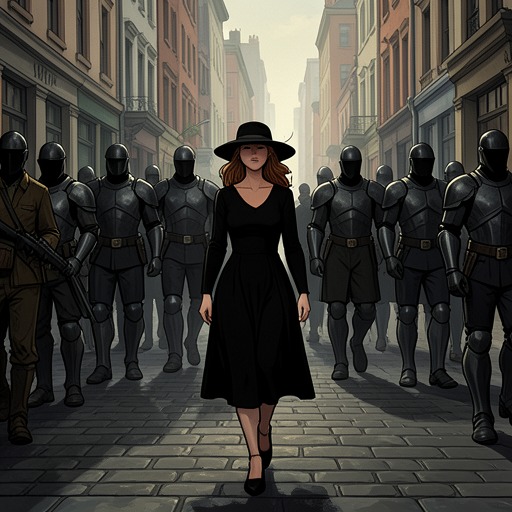
Katalin’s entrance at the Wilson engagement gathering displays vampire authority as a physical spectacle. When the double doors slam, most vampires immediately sink to their knees and bow, while only the humans and a few pure-blood vampires remain standing. Katalin then uses the blue, pulsing shield around her body to open the doors and orders everyone to arise and leave. The vampires obey at once, gliding from the room, followed by the humans.
Once the room has been emptied, Katalin seals the remaining people inside with the closed doors and confronts Jenifer over her disobedience. The scene turns political hierarchy into confinement: the same power that commands a roomful of vampires also makes Jenifer feel caged. Katalin’s controlled authority, her apparent readiness for violence, and the obedience of the assembled vampires make clear that vampire rule is experienced not as an abstract institution but as an immediate force imposed on bodies.
The species is therefore central to the narrative’s movement from ordinary human assumptions toward a coercive supernatural reality. Vampires are simultaneously a biological category, an aristocratic blood order, a ruling government, and the architects of the experiment that has shaped Jenifer since birth. Their promise of strength and continuity is inseparable from exclusion, surveillance, and the willingness to sacrifice human subjects for political stability.